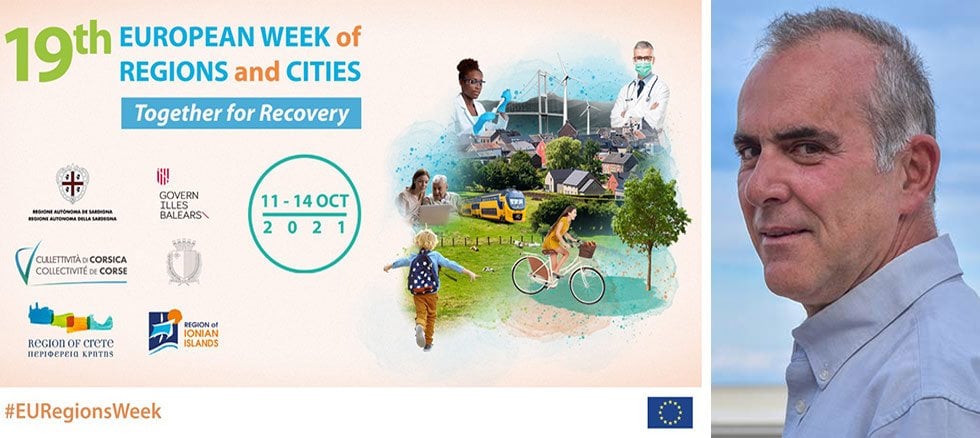
EUREGIONSWEEK2021 – Regional Partnership – Sardegna, Gozo, Baleares, Corsica, Crete, Ionian Islands – 14/10/21
18/10/2021
– Dr. Konstantinos Kapodistrias, vice governor of European programs, Ionian Islands region.
«It is a fact that the pandemic has affected our region deeply. 2020 was a catastrophic year for tourism and therefore for the economy of our islands. Many businesses directly or indirectly linked to tourism did not even open, while those that did operate barely survived. The pandemic affected social interactions and therefore leisure, travel and vacations. The truth is that we were concerned about the survival of businesses and the difficult situation in which tourism workers found themselves.
“Whenever one is forced out of their comfort zone, one becomes more creative and inventive, more innovative and productive. I think this has happened in our islands as well.”
But we philosophized it, which in Greek it means we tried to approach this problem from a philosophical standpoint. As you very aptly stated, any problem can be seen as an opportunity for improvement. Whenever one is forced out of their comfort zone, one becomes more creative and inventive, more innovative and productive. I think this has happened in our islands as well.
The pandemic and the almost catastrophic year of 2020 gave entrepreneurs time to think about the tourism product they offer, to think about upgrading the services provided and to restart their business plans. The pandemic is sure to leave a legacy in the tourist industry which will probably remain even when we return to normalcy. This legacy has already changed customer expectations for safe living conditions in the tourist destination. Some of the health protocols implemented due to COVID-19 will become the norm from now on. Safer vacations, cleaner accommodation, upgraded restaurants and better provision of primary and secondary health facilities in tourist destinations have come to stay.
“What the pandemic has highlighted is the need for a shift to a better model of service delivery. Mass tourism yes, but it needs to be shaped to include quality services and especially health and safety”
We had the opportunity to experience all this already this year. The summer season turned out unexpectedly well for our islands and even today, in mid-October, we are hosting many more tourists than any other year pre-pandemic. But the most important thing is that we succeeded in the challenge of providing a safe destination for holidays. COVID-19 cases were minimal in our region and the number of tourist deaths from the pandemic was almost zero. So at a time when the tourist crowds were very large, the covid cases were so few compared to other parts of Europe and the world, then it means that we did something well. We, the local public authorities responded effectively and timely to assist the tourism professionals to respond to the strict requirements of the health protocols.
” the need for vacation or rather the thirst for vacation is a given. It is also clear that our islands are suitable for summer vacations. But we must realize that customer demands have changed. They have become more refined and selective. They choose safety, cleanliness, the possibility of a high level healthcare if needed and suitable infrastructure.”
What the pandemic has highlighted is the need for a shift to a better model of service delivery. Mass tourism yes, but it needs to be shaped to include quality services and especially health and safety. Clearly, the need for vacation or rather the thirst for vacation is a given. It is also clear that our islands are suitable for summer vacations. But we must realize that customer demands have changed. They have become more refined and selective. They choose safety, cleanliness, the possibility of a high level healthcare if needed and suitable infrastructure. So this must be the direction in which investments in the tourism sector must be diverted. In addition to private investment, the contribution of the state, ie the Ministries, the Municipalities and especially the Region is absolutely necessary in order to promote development and infrastructure projects that will promote the model of safe and quality tourism.
” the upgrading of the infrastructure of primary health care units in our islands should be eligible in the new EU programming period 2021-2027”
The European Union can also help at this point with its financial tools. In this direction, the upgrading of the infrastructure of primary health care units in our islands should be eligible in the new programming period 2021-2027. Entrepreneurship on the islands faces special needs and difficulties which should be acknowledged and strengthened with additional resources. Such resources should be given directly to the Island Regions in order to improve their transport infrastructure (ports and roads) in order to reduce investment costs and improve accessibility to the islands. In addition, in this current age of digital transformation, the necessary digital infrastructure projects should be funded in order for our islands to acquire and provide those possibilities of remote working, distance learning, telemedicine to visitors in order to supercede the problems created by insularity.
“Cooperation in the tourism sector will create opportunities for the development of a new strategy by offering tourism packages that include a combination of destinations belonging to two or more neighboring regions”
One more key element is Interregional and transnational cooperation. Cooperation like the one we are doing here today, with neighboring regions and the development of transport and economic networks can help on multiple levels. In the commercial sector, the promotion of local products to neighboring regions will provide incentives and opportunities for the development of the primary and secondary sectors. Cooperation in the tourism sector will create opportunities for the development of a new strategy by offering tourism packages that include a combination of destinations belonging to two or more neighboring regions. Finally, in the political sector we can achieve more, better and faster. Interreg territorial cohesion programs can play an important role in this direction. The exchange of know-how and experience between the island tourist regions through cooperation and the elaboration of joint programs and endeavours will help towards the successful transition to the new very demanding reality.
The region of the Ionian Islands is the smallest in population region of Greece. Bearing in mind the insularity, this creates in our islands a sense of dual “peripherality”.
At European Union level, the center of decision-making is in Brussels, so the countries of the South are considered as the periphery of Europe.
At the national level, it is a fact that crucial development decisions are made in the center, ie in Athens, where the Ministries and the Central Government are located, without taking into account the particularities and needs of the island regions. Even the final formulation of development programs based on the European Union Structural Funds is approved by the Ministry of Development and the relevant Ministries.
For example, during this period the Ionian Islands Operational Program 2021-2027 is being finalised. The distribution of funds by thematic sector, objectives, eligible projects and actions as well as their selection criteria are determined by the Ministries in cooperation with the Commission and a little bit by the Region. This practice is quite understandable as the regional development strategy needs to be a part of the big picture, it needs to be integrated, in the national development strategy, it cannot be isolated and independent of the rest of the country.
“the specificities of the regions cannot be integrated and merged into general national development policies”
However, sometimes the specificities of the regions cannot be integrated and merged into general national development policies. Insularity, as a feature, cannot be easily addressed in the context of the development strategy of the rest of the mainland area and requires a customized, target oriented, development plan. Such a plan should take into account both the problems facing the islands, such as the isolation and difficulty of transporting people and products, as well as the advantages they have, and especially their tourist attractiveness.
The European Union can and must help in this regard. The resources of the territorial cooperation programs should be strengthened and the funding procedures simplified so that the regions can go directly to Brussels without the intervention of national authorities. It is also very important and we mention it at every opportunity, special financial instruments should be formed to strengthen insularity and incentives should be given for cooperation between the islands.»